Car keys · Woodbridge
Motorcycle & Scooter Keys in Woodbridge
The dash lights come on, the starter cranks, and the engine simply refuses to catch, though the same key has run this bike since it was new. It could be the key and ignition module no longer agreeing, or an ordinary fuel or ignition fault sharing the same…
Motorcycle & Scooter Keys
In plain words
Motorcycle and scooter key service is the work of producing a key that a two-wheeled machine will actually accept, whether that means cutting a plain blade, decoding an ignition lock with no key at all, or programming a transponder that talks to the engine control unit. The locksmith starts by confirming who is asking, then reads the lock and, where fitted, the immobiliser, before choosing whether to cut from an existing key, decode from scratch, or pair a new chip. On many machines the same visit also brings the seat, fuel cap and any storage locks onto the same key as the ignition.
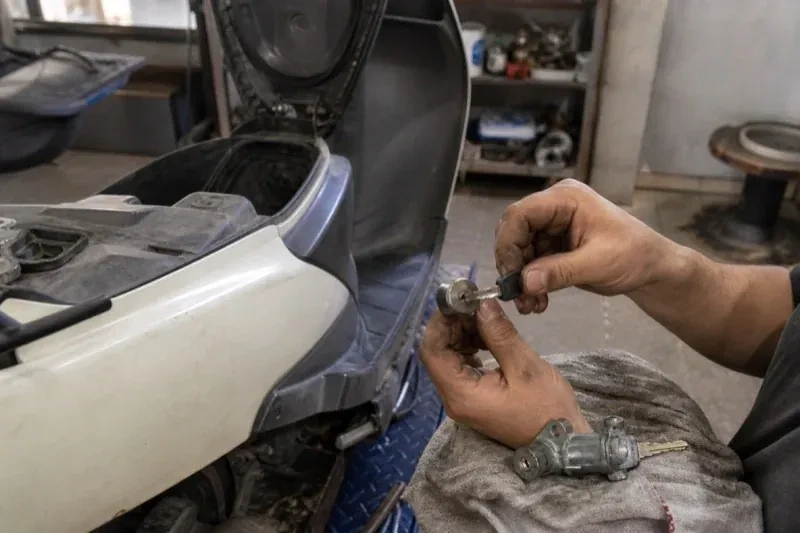
How the visit goesTwo keys came with the scooter: one for the ignition and steering, an entirely different one for the seat and the storage compartment underneath it, so opening the seat means carrying twice the metal.
Woodbridge
How the visit goes
Checking for an immobiliser
Many machines built in roughly the last two decades carry an electronic layer alongside the mechanical lock: a small chip inside the key that the ignition module checks before allowing the engine to run. The locksmith looks for a coil or ring around the ignition barrel, checks whether the dash shows a security alert with the current key, and asks whether the engine cranks without starting, which can point to a chip that is missing, damaged or unpaired, though ordinary fuel, ignition and compression faults produce the same symptom and are checked too. This decides whether the job is a straightforward cut or one that also needs transponder programming.
Cutting from an existing key
When a working key exists, even a spare or a worn original, the more direct route is to read its cuts on a code machine or trace them by hand and cut a fresh blank to match. The new key is checked against the old one under a light before it goes anywhere near the ignition, since a slight misread shows up as a key that almost turns but does not quite lift every wafer. Cutting from a known key is usually the shorter part of the visit, leaving more time for any other locks that need the same treatment.
Looking after a wafer lock
A wafer lock rewards a little occasional attention. Cleaning matters more than lubricant for a wafer lock like this; where the maker calls for it, a puff of the specified lubricant into the keyway once or twice a year keeps the wafers moving freely. Wiping the key itself clean before use, especially after a wet ride, keeps grime from being carried into the lock on every insertion. These are small habits, but they are the difference between a lock that turns the same way for years and one that slowly stiffens.
Motorcycle & Scooter Keys
In the van
- Motorcycle key blanks
- Transponder programming unit
- Manufacturer-approved lock cleaner or lubricant
- Torx and security bits
- Replacement ignition or steering lock
What affects the quote
Same fees day, night or weekend
1Condition of the existing lock
A clean, well-maintained lock accepts a new key with little extra work. One affected by corrosion or grit may need cleaning or light service before a key can be tested reliably against it.
2Sourcing an uncommon key blank
Some keyway profiles are harder to source a matching blank for than others, particularly on older or less common machines, and locating the right blank can add to the time before cutting even starts.
3Number of locks on the machine
A single ignition lock is the simplest case. A machine with a separate seat, fuel cap and storage lock involved is a longer visit with more hardware to read, cut and test.
Motorcycle & Scooter Keys: questions
Why does the number of wafers in a lock matter?
Each wafer represents one depth the key has to hit precisely for the lock to turn, so a lock with more wafers has more combinations and takes a little longer to decode or pick than a simpler one. Most motorcycle locks use around five wafers, and manufacturers sometimes space the depth increments further apart specifically to reduce the chance that an unrelated key happens to fit. This is why an ordinary-looking key rarely works in an unrelated bike.
Can a locksmith program a new immobiliser or transponder key?
On many machines that carry one. The mechanical cut and the electronic pairing are handled as two separate steps: the key is shaped to fit the lock, then its chip is taught to the vehicle's module using an existing key or programming equipment built for that system, where the maker's own security rules allow it. Both steps are tested with a full engine start, since a key can turn the switch and still fail to start the machine if the chip was never paired.
Can the seat, fuel cap and ignition all be set to the same key?
On many serviceable, compatible systems, yes. Each lock is opened and its internal wafers are replaced with a set cut to match the ignition's combination, the same principle used to rekey a house lock applied to smaller hardware. Every lock is tested individually afterward so the finished key is confirmed against each one rather than assumed to work. Locks that were never on the same key from the factory can usually be brought together this way during one visit.
Car Keys
- Car Key ReplacementThe only key to the car went into the lake with the kayak.
- Spare Car Key DuplicationA car sits at the cottage all season, and the only key to it lives on a ring three hours away in…
- Key Fob ProgrammingThe remote clicks the way it always has, but the vehicle no longer locks, unlocks or answers with…
Motorcycle & Scooter Keys near you
Every lock service we provide in Woodbridge starts with the same first step, which is looking at the door properly before deciding anything. The individual pages below explain what that look involves for each job, how the work is carried out, and what to expect from the hardware afterwards.