Car keys · Vaughan
Motorcycle & Scooter Keys
The dash lights come on, the starter cranks, and the engine simply refuses to catch, though the same key has run this bike since it was new. It could be the key and ignition module no longer agreeing, or an ordinary fuel or ignition fault sharing the same…
Motorcycle & Scooter Keys
In plain words
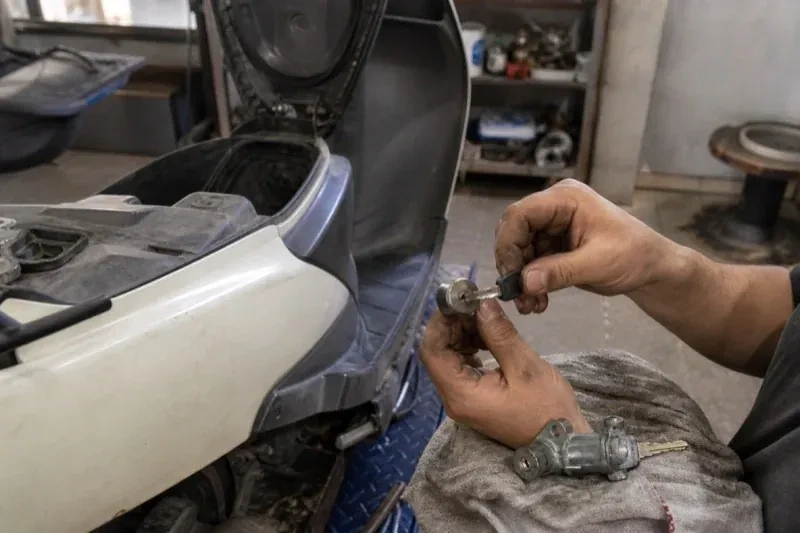
A motorcycle rarely has just one lock. The ignition and steering are usually paired, the seat has its own latch, and older machines add a keyed fuel cap, each of which may or may not share a cut with the others depending on how the factory keyed it. Key service starts by mapping which locks are on the machine and which of them the owner wants running from a single key, and bringing a seat or fuel-cap lock onto the ignition's cut is common where those cylinders are compatible and serviceable, though some models need a matched lock set instead.
How the visit goesThe bike came home from its previous owner with a single worn key that starts the engine but does nothing for the seat latch or the fuel cap, both of which answer to keys nobody handed over.
Vaughan
How the visit goes
Reading the lock family
Every motorcycle lock has a shape and a history that tells the locksmith what they are working with. The keyway profile, the number of wafers, whether the plug is single- or double-sided, and any maker's mark on the lock face narrow down which key blank and which cutting code apply. Manufacturers reuse wafer counts across very different keyway profiles, so a lock that looks similar to another model can still refuse a blank cut for it. Identifying the lock correctly before cutting anything is what keeps the first key made for the machine the right one.
Cleaning and servicing a corroded lock
A lock gummed up by road grit or old grease is stripped down, its wafers and springs cleaned individually, and the keyway itself cleared of anything trapped against the wafers. Corrosion on a wafer's edge is worked off carefully rather than scraped away roughly, since removing metal changes the depth the key needs to lift it to. Once the mechanism moves freely again, it is dressed with whatever lubricant its own maker specifies, reassembled, and tested with the customer's key before the locksmith considers the lock itself resolved rather than simply hidden under a new cut.
A record worth keeping
A short written note of what was done, whether the lock was cut from an existing key, decoded from scratch, or paired as a new transponder, is worth keeping with the machine's other paperwork. It answers a question that often comes up later: whether a particular key is original or a replacement, and whether other locks on the bike were brought onto the same cut. For a machine that changes hands again down the road, that note saves the next owner from starting the same process from a single worn key and no history.
Motorcycle & Scooter Keys
In the van
- Motorcycle key blanks
- Transponder programming unit
- Manufacturer-approved lock cleaner or lubricant
- Torx and security bits
- Replacement ignition or steering lock
What affects the quote
Same fees day, night or weekend
1Whether a working key already exists
Whether a working key still exists changes the job considerably: cutting or duplicating from one is the more direct route, while decoding a lock with nothing to reference takes longer and shapes the time reflected in the total.
2Number of new keys cut
Keys cut on site are counted individually. Two for a rider and a partner, or several for a household that shares the machine, is reflected directly in the total.
3Condition of the existing lock
A clean, well-maintained lock accepts a new key with little extra work. One affected by corrosion or grit may need cleaning or light service before a key can be tested reliably against it.
Motorcycle & Scooter Keys: questions
Why does the number of wafers in a lock matter?
Each wafer represents one depth the key has to hit precisely for the lock to turn, so a lock with more wafers has more combinations and takes a little longer to decode or pick than a simpler one. Most motorcycle locks use around five wafers, and manufacturers sometimes space the depth increments further apart specifically to reduce the chance that an unrelated key happens to fit. This is why an ordinary-looking key rarely works in an unrelated bike.
Can a locksmith program a new immobiliser or transponder key?
On many machines that carry one. The mechanical cut and the electronic pairing are handled as two separate steps: the key is shaped to fit the lock, then its chip is taught to the vehicle's module using an existing key or programming equipment built for that system, where the maker's own security rules allow it. Both steps are tested with a full engine start, since a key can turn the switch and still fail to start the machine if the chip was never paired.
Can the seat, fuel cap and ignition all be set to the same key?
On many serviceable, compatible systems, yes. Each lock is opened and its internal wafers are replaced with a set cut to match the ignition's combination, the same principle used to rekey a house lock applied to smaller hardware. Every lock is tested individually afterward so the finished key is confirmed against each one rather than assumed to work. Locks that were never on the same key from the factory can usually be brought together this way during one visit.
Car Keys
- Car Key ReplacementThe only key to the car went into the lake with the kayak.
- Spare Car Key DuplicationA car sits at the cottage all season, and the only key to it lives on a ring three hours away in…
- Key Fob ProgrammingThe remote clicks the way it always has, but the vehicle no longer locks, unlocks or answers with…
Motorcycle & Scooter Keys near you
Whether you own a home in Vaughan, run a shop or manage a few rental units, the lock services here are organised the way people actually ask for them. Start with the problem you have today, and read on to see what else on the door might deserve a look while a locksmith is already there.