Commercial · Woodbridge
Master Key System Design in Woodbridge
A new hire at the shop gets handed whatever spare key happens to be in the drawer, and it turns out to open the stockroom, the back office and the safe room all at once. The owner realizes nobody actually decided who should open what.
Master Key System Design
In plain words
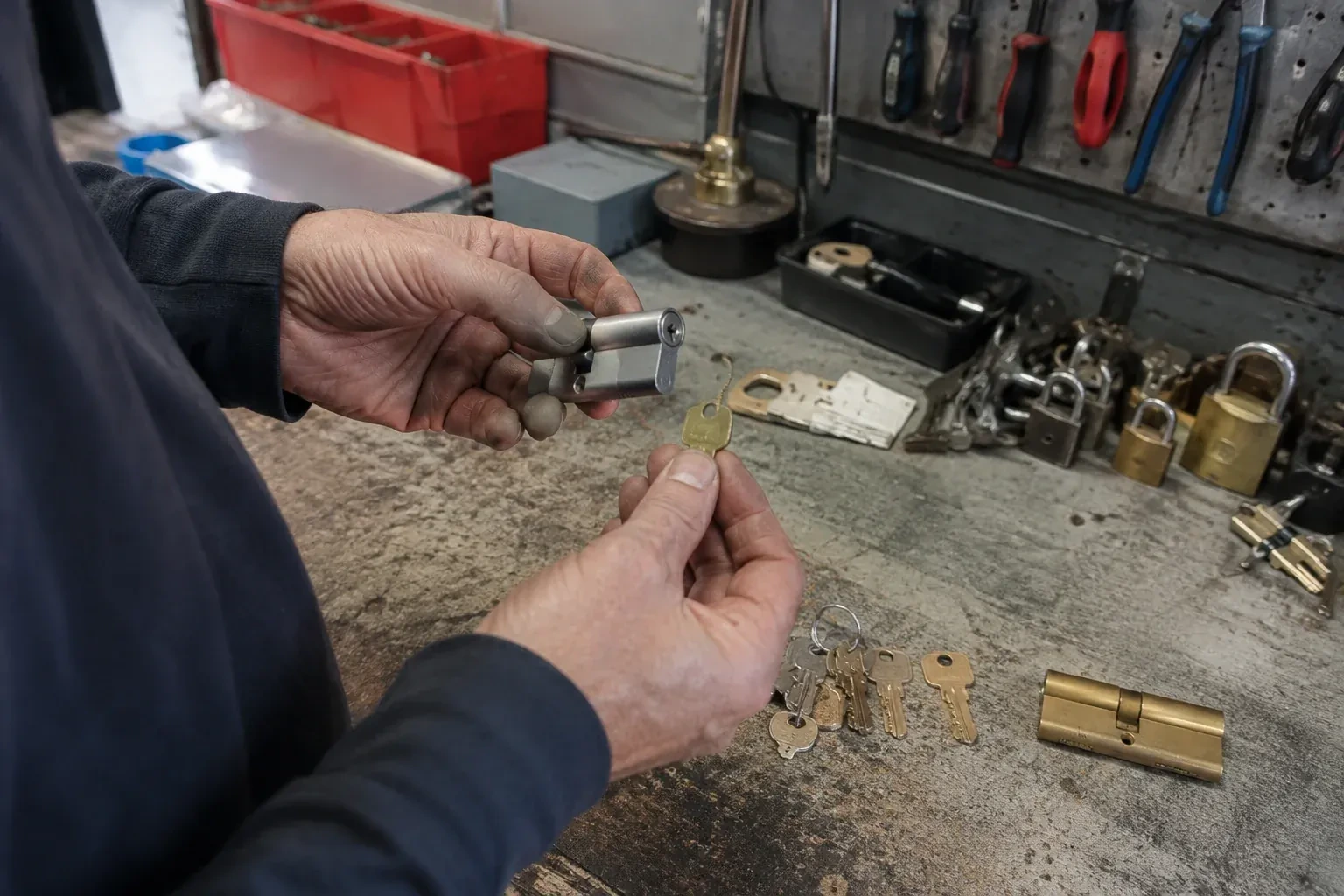
Many commercial properties end up with keys copied from other keys over years of staff changes, until nobody can say with confidence what a given key actually opens. Master key system design starts from the opposite direction: an approved list of roles and openings comes first, and the keying follows it. Doors that genuinely need to share access are grouped under a sub-master; doors that do not stay on their own key. Once the hierarchy is agreed, the cylinders are pinned to match it, tested lock by lock, and handed over with a plain record so the business always knows which key belongs where.
How the visit goesThe new wing was built with its own brand of cylinder, so the two-year-old keys from the original building do not open a single door in the addition. Staff are now carrying two separate key rings just to move around one workplace.
Woodbridge
How the visit goes
Where a sub-master genuinely earns its place
Not every group of doors needs its own level. The assessment looks for places where a sub-master is a real convenience, such as a department, a floor, or a set of storage rooms used by the same small team, rather than adding levels for their own sake. A hierarchy with more levels than the business actually uses is harder to manage and easier to get wrong later, so this stage is as much about deciding what not to build as it is about what to include, before any pins are cut or any key blanks are ordered.
Bringing electronic and mechanical access into one plan
Where a property mixes mechanical cylinders with keypad or card-based doors, the mechanical hierarchy is designed to line up with the electronic access groups rather than run as a separate, unrelated system. A department that sits at one sub-master level on the mechanical side is kept at a matching level on any electronic doors it also uses, and any mechanical override cylinders behind an electronic lock are pinned into the same chart as every other door, so one document still describes the whole property.
Room already built in for what comes next
Because spare capacity was planned into the keying platform from the start, a realistic new door, tenant or hire usually fits into the existing chart without disturbing levels that are already in use. This is the practical payoff of building the system with growth in mind rather than filling every available combination on the first day: expansion becomes an addition to the record, not a reopening of it.
Master Key System Design
In the van
- Key cutting machine
- Keying chart
- Key marking tools
- Locking chart storage cabinet
- Bench test fixture
What affects the quote
Same fees day, night or weekend
1Working around an occupied, operating property
Rekeying doors in a planned sequence so a business keeps operating throughout, rather than all at once, takes coordination with the owner's schedule. Properties that need this staged approach, with interim arrangements for doors mid-conversion, add planning time beyond a straightforward, all-at-once installation.
2Number of doors and levels involved
A single office with one change key and no sub-master is a simpler project than a multi-floor property with several departments and a top-level master. The quote reflects how many doors are assessed, how many levels are designed, and how many cylinders are pinned to match those levels.
3Sub-master levels beyond the basics
One or two sub-master levels are typical for most properties. A more elaborate hierarchy, with several sub-masters covering overlapping departments or floors, takes longer to design correctly and test, and that additional design and testing time is reflected in the quote.
Master Key System Design: questions
Can key duplication be restricted so copies cannot be cut elsewhere?
Yes. With a restricted or patented keyway, blanks are only available through the manufacturer's authorized record, so a copy is not cut at an ordinary hardware counter without going through that channel. This does not make a key impossible to duplicate, but every legitimate copy passes through a record the owner controls, which a standard keyway cannot offer.
What is a master key system, in plain terms?
It is a set of keys arranged in levels rather than issued one at a time. An individual change key opens one door, or a small group of doors keyed alike. A sub-master opens a defined group of doors, such as everything on one floor. A single top-level master opens the whole set. The levels are designed around who actually needs each one, then cylinders are pinned to match, so the physical keys follow an organization's real structure instead of years of informal copying.
What does key control actually mean?
It means knowing, at any time, how many keys exist for a given door or level, who holds each one, and how a new copy would be authorized. A master key system supports key control by design, since keys are marked by role, logged by serial, and cut only against the chart, rather than copied informally whenever someone asks for one.
Commercial Locks
- Access Control InstallationThe back door of the shop runs on one key, and by now it lives on six different rings: yours, two…
- Panic & Exit HardwareSomeone at the front counter always has to unlock the side door by hand before the lunch rush…
- Commercial-Grade Lock ReplacementThe kitchen delivery door gets shouldered open more than a hundred times a shift, and lately the…
Master Key System Design near you
Every lock service we provide in Woodbridge starts with the same first step, which is looking at the door properly before deciding anything. The individual pages below explain what that look involves for each job, how the work is carried out, and what to expect from the hardware afterwards.