High security · Kleinburg
Safe Installation & Servicing in Kleinburg
The office is moving three blocks over, and the old commercial safe that has sat bolted to the concrete for fifteen years now needs to come out, travel across town, and go back down just as solidly.
Safe Installation & Servicing
In plain words
The lock on a safe is either a mechanical dial built around a wheel pack and gates, set and tested by a trained hand, or an electronic keypad running on batteries, and each has its own service needs. A new mechanical lock is set to a combination chosen by the owner and tested through a full open-and-close cycle before installation is called finished. An electronic lock gets fresh batteries, a reprogrammed code, and a check that the low-battery warning actually sounds before it dies. Either way, nobody but the owner leaves with the working combination or code.
How the visit goesThe keypad on the office safe blinks a low-battery warning every morning now, and whoever notices it first quietly hopes someone else deals with it before the batteries finally give out mid-week.
Kleinburg
How the visit goes
What kind of lock is already, or will be, on the door
A mechanical dial and an electronic keypad are serviced differently, so the lock gets identified early. On a new installation this is a straightforward choice by the owner. On an existing safe, the locksmith checks whether the dial turns smoothly through a full combination, whether an electronic keypad still lights up and accepts a code, and whether a hidden mechanical override exists behind the keypad in case the batteries run flat. Any handle that binds or clicks without retracting the bolt gets traced back to the lock before the rest of the service continues.
Anchoring into a concrete floor
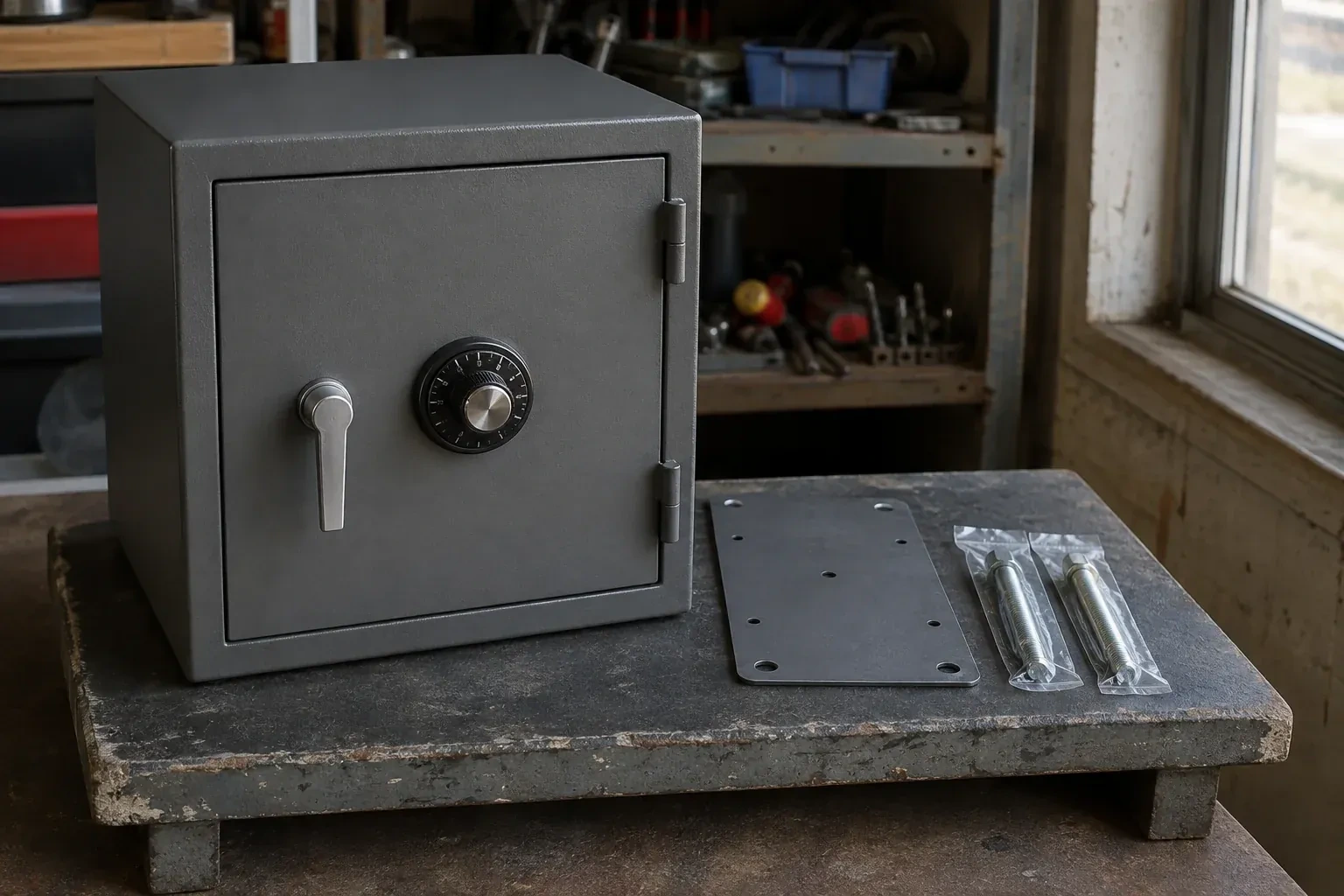
On a concrete floor, holes are drilled through the safe's pre-cut anchor points with a hammer drill and a masonry bit sized to the anchor hardware, and the dust is cleared from each hole so the anchor seats fully rather than on loose grit. Concrete anchor bolts are driven in and torqued to the hardware manufacturer's specification, tight enough to resist prying but not so tight that the anchor or the safe's own steel is stressed. The safe is tested afterward by hand to confirm it does not rock or shift.
Batteries that get changed before they fail
An electronic lock gives some warning before it dies, usually a beep or a flashing light during normal use, and treating that warning as a job to do that same week rather than eventually is what keeps a dead battery from turning into a locked-out morning. Keeping a spare battery of the correct type near the safe, rather than searching for one after the warning starts, closes the loop. The mechanical override key behind the keypad is worth keeping somewhere separate from the safe itself, not taped underneath it.
Safe Installation & Servicing
In the van
- Concrete anchor bolts
- Torque wrench and socket set
- Mechanical or electronic lock
- Rated safe (burglary and fire)
- Hammer drill and masonry bits
What affects the quote
Same fees day, night or weekend
1Anchoring difficulty at the chosen spot
A straightforward concrete floor is the simplest case, while a wood subfloor needing joist location, or a tiled surface needing an alternative fastening point, both add steps to the anchoring work.
2Requests for concealment
Fitting a safe into a closet floor, a recessed wall cavity, or behind a built-in panel takes more planning than a straightforward open placement, and can limit which units will actually fit.
3Building access restrictions
A property requiring a booked loading dock, a service elevator reservation, or coordination with building management before a heavy delivery can arrive adds scheduling steps beyond the installation work itself.
Safe Installation & Servicing: questions
What happens if a previous owner's combination is unknown?
That situation calls for opening the safe first, which is handled as its own service using non-destructive methods wherever the lock allows, before a new combination or code is set. Once open, the installation or servicing continues as normal: the lock is checked, the anchoring is confirmed or fitted, and a fresh combination known only to the current owner is set before the visit ends.
What information should I have ready before requesting a quote?
Knowing roughly what the safe will store, whether it is a new purchase or an existing unit, and what floor or wall it will sit against covers most of what shapes the visit. If the safe is already on site, its approximate weight and dimensions help too, along with whether it currently has a working lock and combination. An insurer's stated rating requirement, if there is one, is worth mentioning as well.
How do I decide between a bigger safe now or upgrading later?
It comes down to how much the amount being stored is likely to grow over the next few years. A safe sized with some room to spare avoids an early repeat visit, while a unit sized exactly for today's needs can be outgrown within a year or two for a growing business. Anchoring and lock work do not change much with size, so the main trade-off is simply the footprint the larger unit takes up in the room.
High Security Locks
Safe Installation & Servicing near you
Lock work in Kleinburg is rarely just one thing. A lockout often reveals a worn cylinder; a rekey is a good moment to fix a strike that never lined up. The services below are described one at a time, but a locksmith at your door will happily point out anything else worth doing while he is there.